Participative Design Workshop
The OST method for changing an organisation's design principle from DP1 to DP2, by having the people who do the work redesign their own structure for genuine democratic participation.
The Participative Design Workshop (PDW) is a structured workshop in which the people who do the work redesign how their own work is organised. They analyse what they currently do, identify what gets in the way, and design a new structure that puts coordination and control of the work with the team doing it.
The point of a PDW is to deliver a strategic plan. Step one of the two-stage model is a Search Conference, which produces the plan; step two is a PDW, which redesigns the organisation so it can actually carry the plan out. Without the second step, the existing structure quietly reshapes the plan to fit what it can already do, and the strategy is lost. No one runs a PDW for the sake of reorganising — it is run to make a plan real.
The PDW does this by moving the organisation from a hierarchy of dominance (DP1) to a non-dominant hierarchy of function (DP2). Structure is what actually decides how an organisation behaves: training, engagement programmes and leadership coaching tend to revert when the underlying structure is left in place. Changing the structure itself is what makes the new strategy land, stick, and give people the conditions to do good work.
PDWs are typically run with as many workers from an organisation or section as possible, usually 24 to 36 people at a time, working in small groups of 6 to 8. The workshop focuses on real business needs, management priorities and parameters, and the logistics of redesigning the work. Participants analyse their current work, design new adaptive structures, and plan the action steps required to put their designs into practice.
The PDW is the second method in the OST two-stage model: a Search Conference produces a strategic plan; a PDW produces the DP2 structure that can implement it.
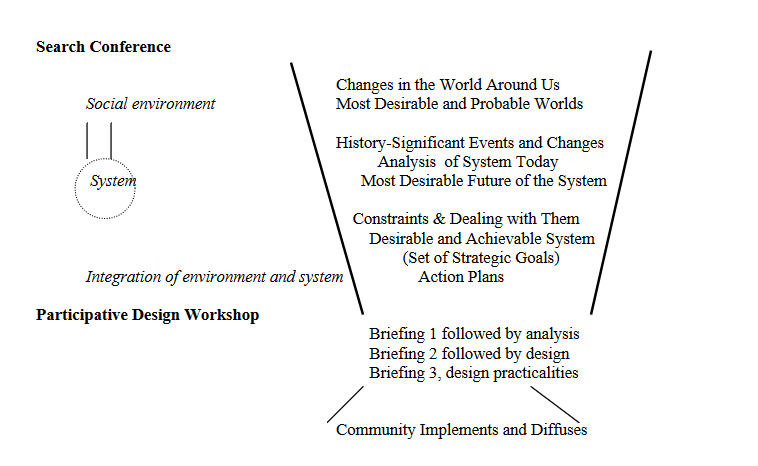 Where the PDW sits in the two-stage model. The Search Conference narrows from world to action plans; the PDW then opens those plans out into briefings, design, practicalities and community-wide implementation. Diagram from Merrelyn Emery, Open or Closed Systems? Bridging the Gap, February 2012.
What the PDW changes, and why
The design principle of an organisation drives its intrinsic motivators, which in turn drive motivation, enabling factors, and outcomes. Change the design principle and the rest of the pattern shifts. Leave the design principle in place and most other interventions, including engagement programmes, skills training and leadership coaching, eventually revert. The PDW is the lever that moves the principle itself.
This is also why a PDW is not team-building, culture change, or matrix management. It does not improve interpersonal skills or redraw reporting lines while leaving control located above the work. It relocates coordination and control of the work with the group doing the work, in every group, or it has not been done.
How a PDW runs
The standard PDW has three phases, each opened by a short briefing delivered with diagrams.
Phase 1: Analysis (DP1). The group makes the current state visible to itself.
- Map the workflow. Where does the work come in, what happens to it, who does what to it, and where does it go from there. This surfaces the natural breakpoints for group boundaries.
- Map the current formal structure as it actually stands, with real people in real positions.
- Run a skills audit and skills matrix. What essential skills and knowledge does the work require, and which people hold them (0 for none, 1 for enough to back up, 2 for expert). This reveals single-expert risks and surplus capacity.
- Score participants’ recent experience of the work against the Six Criteria. This produces lived data on what is wrong with the current design.
- Deliver Briefing 1 on DP1 and its consequences, connecting the structure on the wall to the experience already in the room.
Phase 2: Change (DP2). The same groups redesign the structure.
- Deliver Briefing 2 on DP2 and its consequences, with worked examples of the main DP2 forms (basic multi-skilled groups, specialist coordination, project-team forms).
- Redesign the structure to DP2. The workflow stays as it is; the structure around it changes. Participants spell out coordination mechanisms, timeframes, and how the new groups will operate.
- Re-check the skills matrix against the new design, and plan how to obtain anything missing.
Phase 3: Practicalities. The groups make the new design workable.
- Deliver Briefing 3, which adds five things to the design: comprehensive measurable goals, training requirements, career paths (if required), an open “what else” category covering layout, technology and anything not yet picked up, and a Six Criteria score of the new design that participants can compare against the current one.
- Group reports and integration across the sub-groups.
The PDW can be done in a day. It is also highly flexible in scheduling. Briefings can be spread across shifts, across days, or across weeks, which means a PDW can run while operations continue. (The Search Conference is not flexible in this way.)
What a PDW produces
A non-dominant hierarchy of function, typically two or three levels (strategic, resource, operational) depending on organisation size, with self-managing groups at every level and relations between groups conducted as negotiations between peers. Coordination and control of the work sit with the people doing the work. The new design is owned by the people who built it, which is why PDW designs hold where consultant-imposed restructures do not.
Knowledge transfer, not consulting dependency
“The PDW is fundamentally a knowledge-transfer job. Employees must learn to do it themselves.”
Merrelyn Emery
External facilitators are training wheels. A successful PDW programme leaves the organisation able to run its own PDWs going forward; otherwise it stays dependent on outside help and the work does not last. Large rollouts typically train internal facilitators in parallel with the first wave of workshops.
Preparation matters
A PDW is not a workshop that can be dropped onto an organisation. An eight-element preparation and planning phase comes before the workshop runs. It covers executive understanding of DP2, stakeholder briefings, scope agreement, logistics, and internal facilitator training, among others. Skipping this preparation is the most common reason PDW programmes fail. PDWs work; unprepared PDWs do not.
How the PDW fits with the Search Conference
The two methods are independent and complete in themselves, and they are also complementary. The two-stage model — a Search Conference followed by a modified PDW — is the standard way to ensure a strategic plan does not dissipate into committees and instead lands in a structure that can carry it out. See the OST Primer for a side-by-side comparison of the two methods.
Try the tools
The Six Criteria scoring used in a PDW can be run as a stand-alone team exercise using Workgroup Pulse at oostkit.com.