The external social environment is constantly changing, people’s beliefs, values, and expectations shift rapidly, affecting the decisions they make. This environment produces discontinuous change, making it feel like the ground is shifting beneath our feet. How does this inform the decisions we take in an organisational context.
The defining characteristic of the Open Systems Theory is that the system of work exists within a context. Changes to the world we live in inform the decisions we make. The problem with most systems models and frameworks we have worked with is that they are applied without context. Often it is left to the change practitioner to bring their own nuance to the change they are implementing. OST starts with the environment and how it affect the system and considers the likely and best possible futures for the system within the environment.
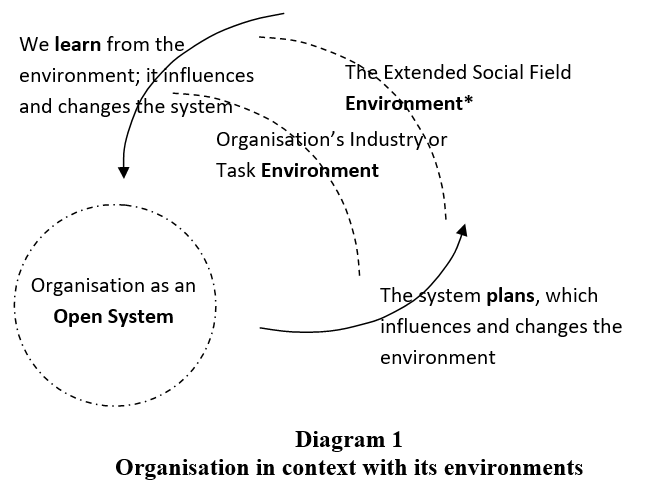
Organisations do not exist in a vacuum. Every organisation sits inside an environment — its industry, its markets, the wider social field — and the two are in constant conversation. The environment shifts, and the organisation has to read those shifts and adapt. The organisation acts, and those actions feed back into the environment around it.
That two-way exchange is what makes a system open. A closed system would treat the outside world as background noise; an open system treats it as the starting point. Learning is how the organisation stays viable: it picks up signals from the environment, makes sense of them, and adjusts how it works. The plans it makes then become part of the environment that everyone else is reading.
This is why OST methods always begin with the environment rather than the organisation. Before you can design good work, you need a shared picture of the world that work is happening in.
Diagram from “Open or Closed Systems? Bridging the Gap” — Merrelyn Emery (February 2012).