Search Conference
A 2.5-day participative strategic planning process for organisations and communities operating in turbulent environments. The first half of the OST two-stage model.
All organisations and communities today need to periodically take stock of themselves in their rapidly changing environments and plan more adaptive directions and futures. In highly uncertain environments, business leaders must be able to answer: ‘Where do we want to be in five to seven years within the context of this uncertainty?’
The Search Conference (SC) is a proven strategic planning process for organisations and communities operating in turbulent and uncertain environments.
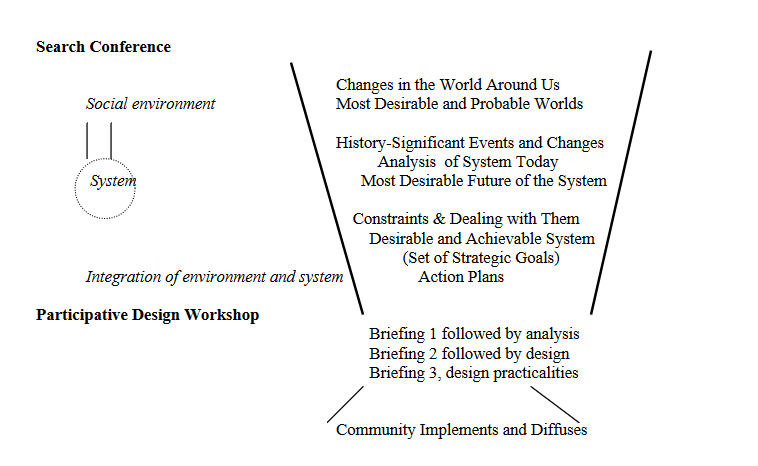 The Search Conference funnels a group’s attention from the wider environment down to a concrete set of action plans.
Diagram from Merrelyn Emery, Open or Closed Systems? Bridging the Gap, February 2012.
The Search Conference funnels a group’s attention from the wider environment down to a concrete set of action plans.
Diagram from Merrelyn Emery, Open or Closed Systems? Bridging the Gap, February 2012.
Today the SC is a proven process for reliable and effective strategic planning that can be used by any organisation, community, national or international group to address their future. It has the power to produce cohesive, cooperative management and community groups who become, and stay committed to making their futures. By partaking in a SC, participants are not only committed to making their own futures, but they also learn about the SC process itself so that they can continue to adaptively change.
For organisations attempting to adapt to highly unpredictable environments caused by unstable value systems and amplified by factors such as the accelerating uptake of AI, work from home and digital platform technologies, they are all too often running from one new change management fad to the next. However, applying the SC affords greater control of their destinies.
By undertaking an organisational SC, management can:
- Develop a strategic framework within which other improvement strategies such as benchmarking, value adding partnerships, etc can be integrated and aligned with overall strategic objectives
- Explore changing market and industry conditions so that the plan developed reflects, and is responsive to, the changing environment
- Plan their future as a cohesive unit
- Maintain commitment to implementing their future plans by designing and organising themselves into cooperative and responsive self-managing groups
Organisations and communities as ‘Open Systems’
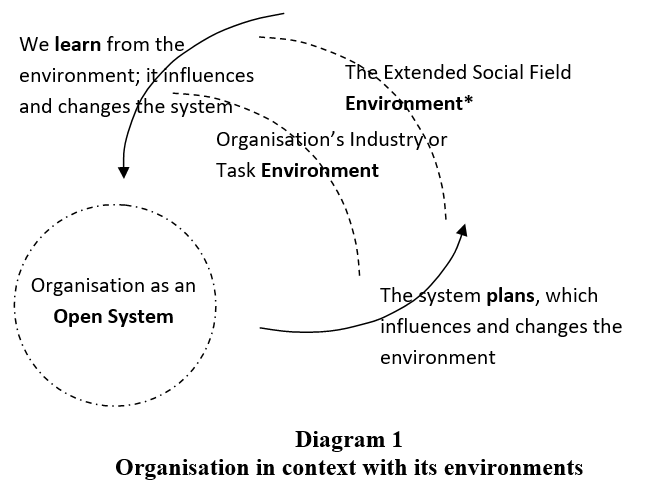
Organisations and communities are open systems: they shape their environments over time, and are shaped by them in return. Staying viable means keeping that exchange active and adaptive — a healthy open system moves in step with the world around it.
Designing a Search Conference starts from this premise. The method makes the relationship between a system and its environments visible to the people in the room, so they can plan from a shared, realistic picture.
There are two environments to attend to: the task environment (the industry or field the system operates in) and the extended social field (the wider world beyond it). The diagram below shows how they nest.
The Search Conference is a participative, facilitated 2.5-day method for strategic planning, with a proven set of steps tested over 50 years of development, practice and theory. Participants are those responsible for the health and direction of the organisation and those responsible for implementing the strategy. It is typically run for a cohort of 20–40 people.
The Search Conference is part one of the OST two-stage model. The second part is the Participative Design Workshop (PDW), and the two are designed to work together.
A plan on its own is not enough. If a fresh strategy is handed back to the existing organisation, implementation is likely to fail. A system does what it is designed to do — feeding it a new plan does not change its outputs. To deliver something different, the organisation itself has to be redesigned around the strategy. That is the job of the PDW.
This is the most common failure mode in strategic planning. An organisation invests in producing a good plan, then leaves the existing structure untouched. The plan is gradually reshaped to fit what the structure can actually deliver, the original intent is lost, and the strategy quietly fails. Running a PDW after the SC is what closes that gap.
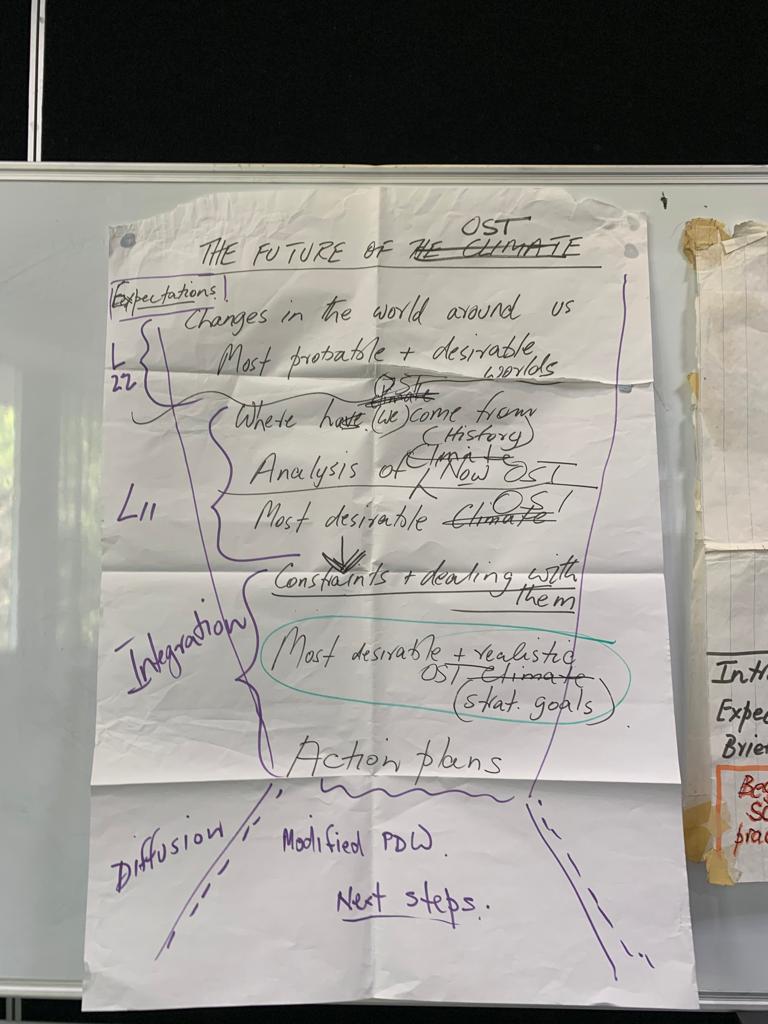 From the workshop floor — a facilitator’s flipchart walking the group through the SC agenda.